

Hey there! I'm a supplier of bio-based furfuryl alcohol, and today I'm super stoked to walk you through how this amazing stuff is produced.
First off, let's talk about what bio-based furfuryl alcohol is. It's a green alternative to traditional furfuryl alcohol. It's used in a bunch of industries, like making Green Chemical Furfuryl Alcohol, Industrial Furfuryl Alcohol, and as a Furan Resin Raw Material. It's eco - friendly and has a whole bunch of cool applications.
The Starting Point: Biomass
The production of bio - based furfuryl alcohol starts with biomass. Biomass is basically any organic material that comes from plants or animals. For our purposes, we usually use agricultural waste like corn cobs, sugarcane bagasse, and rice husks. These are great because they're abundant and would otherwise go to waste.
The reason we can use these materials is that they contain a compound called hemicellulose. Hemicellulose is a type of polysaccharide, which is just a fancy word for a long chain of sugar molecules. In the case of hemicellulose, it contains a lot of xylose, a five - carbon sugar.
Step 1: Hydrolysis
The first major step in making bio - based furfuryl alcohol is hydrolysis. Hydrolysis is a chemical reaction where water is used to break down a compound. In our case, we use an acid catalyst to break down the hemicellulose in the biomass into its individual sugar molecules, mainly xylose.
We put the biomass in a reactor and add an acid, usually sulfuric acid or hydrochloric acid, along with water. The acid speeds up the reaction, and under high temperature and pressure, the hemicellulose breaks apart. This process is carefully controlled because we want to maximize the yield of xylose while minimizing the formation of unwanted by - products.
Once the reaction is complete, we have a mixture that contains xylose, along with some other sugars and impurities. We then need to separate the xylose from the rest of the stuff. This is usually done through a series of filtration and purification steps. We use filters to remove any solid particles, and then we might use techniques like ion exchange chromatography to remove the acid and other impurities.
Step 2: Dehydration
After we've got our pure xylose, the next step is dehydration. Dehydration is the opposite of hydrolysis; it's a reaction where water is removed from a compound. In this case, we want to turn xylose into furfural.
We put the xylose in another reactor and add a dehydration catalyst. A common catalyst for this reaction is a solid acid catalyst, like zeolites or ion - exchange resins. These catalysts help to remove three molecules of water from each xylose molecule, turning it into furfural.
The reaction usually takes place at a high temperature, around 150 - 200 degrees Celsius. We also need to control the pressure and the flow rate of the reactants to ensure a good yield of furfural. Furfural is a yellowish liquid with a distinct odor, and it's an important intermediate in the production of furfuryl alcohol.
Just like after hydrolysis, we need to purify the furfural. We use distillation to separate the furfural from any unreacted xylose, water, and other by - products. Distillation works because different compounds have different boiling points. We heat the mixture, and the furfural, which has a lower boiling point than some of the other components, vaporizes first and can be collected.

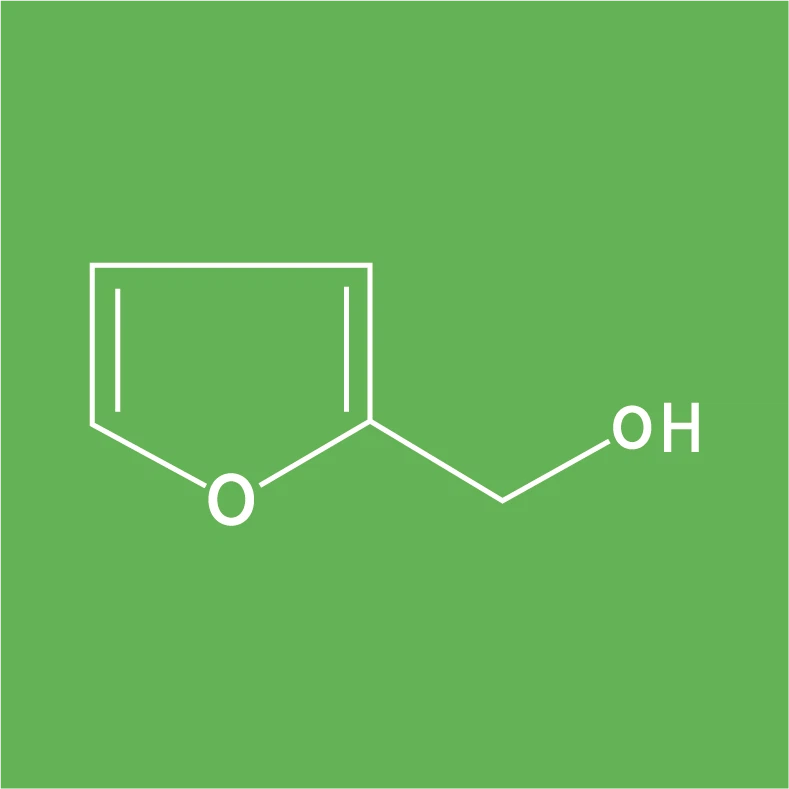
Step 3: Hydrogenation
Now that we have our pure furfural, it's time to turn it into furfuryl alcohol. This is done through a process called hydrogenation. Hydrogenation is a reaction where hydrogen is added to a compound.
We put the furfural in a hydrogenation reactor and add a hydrogenation catalyst. Common catalysts for this reaction are nickel, copper, or palladium - based catalysts. The reactor is filled with hydrogen gas, and under high pressure and temperature, the hydrogen reacts with the furfural.
The hydrogen adds to the carbon - oxygen double bond in the furfural molecule, turning it into a single bond and forming furfuryl alcohol. The reaction is exothermic, which means it releases heat. So, we need to have a good cooling system in place to control the temperature.
After the reaction is complete, we again need to purify the furfuryl alcohol. We use distillation one more time to separate the furfuryl alcohol from any unreacted furfural, hydrogen, and other impurities. The final product is a clear, colorless liquid that's ready to be used in various applications.
Quality Control
Throughout the entire production process, we have strict quality control measures in place. We test the raw materials to make sure they meet our standards in terms of hemicellulose content and purity. During each step of the process, we take samples and analyze them using techniques like high - performance liquid chromatography (HPLC) and gas chromatography - mass spectrometry (GC - MS).
These techniques allow us to determine the composition of the mixtures at each stage, so we can make sure the reactions are going as planned and that the purity of our products is high. We also test the final furfuryl alcohol for its physical and chemical properties, like density, boiling point, and acidity.
Advantages of Bio - based Furfuryl Alcohol
There are several advantages to using bio - based furfuryl alcohol. First of all, it's environmentally friendly. Since we're using agricultural waste as our raw material, we're reducing the amount of waste that goes to landfills. And compared to traditional furfuryl alcohol production methods that use non - renewable resources, our process has a much lower carbon footprint.
Secondly, bio - based furfuryl alcohol has the same high - quality performance as traditional furfuryl alcohol. It can be used in all the same applications, like in the production of furan resins, which are used in foundry applications to make molds and cores.
Why Choose Our Bio - based Furfuryl Alcohol
As a supplier, we're committed to providing the highest quality bio - based furfuryl alcohol. We've invested in state - of - the - art production facilities and have a team of experts who are constantly working to improve our processes.
We also offer competitive pricing because we've optimized our production to be as efficient as possible. And we're flexible with our order sizes, whether you need a small amount for research purposes or a large quantity for industrial production.
If you're in the market for bio - based furfuryl alcohol, I'd love to talk to you. Whether you're involved in the green chemical industry, industrial manufacturing, or using it as a furan resin raw material, we can provide you with the product you need. Reach out to us to start a conversation about your requirements and how we can work together.
Conclusion
So, there you have it! That's how bio - based furfuryl alcohol is produced. From using agricultural waste to creating a high - quality, eco - friendly product, it's a fascinating process. If you have any questions or are interested in purchasing bio - based furfuryl alcohol, don't hesitate to get in touch. We're here to help you find the best solution for your needs.
References
- Smith, J. (2018). "Biomass Conversion Technologies". Elsevier.
- Johnson, A. (2019). "Advances in Furfural Production from Renewable Resources". Journal of Sustainable Chemistry and Engineering.
- Brown, C. (2020). "Catalytic Processes for the Production of Furfuryl Alcohol". Chemical Engineering Journal.


