

Hey there! As a supplier of food grade furfural, I'm often asked about its various properties. Today, I'm gonna dive into one of the less - talked - about aspects: the acoustic properties of food grade furfural.
First off, let's understand what furfural is. Furfural is an organic compound derived from agricultural by - products like corncobs, oat hulls, and sugarcane bagasse. It's a versatile chemical with a wide range of applications, from Biobased Furfural for Biofuels to Furfural Chemical and Furfural Preservative. But when it comes to its acoustic properties, things get a bit more niche.
Acoustic properties refer to how a substance interacts with sound waves. This includes factors like sound absorption, sound transmission, and sound reflection. For food grade furfural, these properties can have implications in different industries, especially those where noise control is crucial.
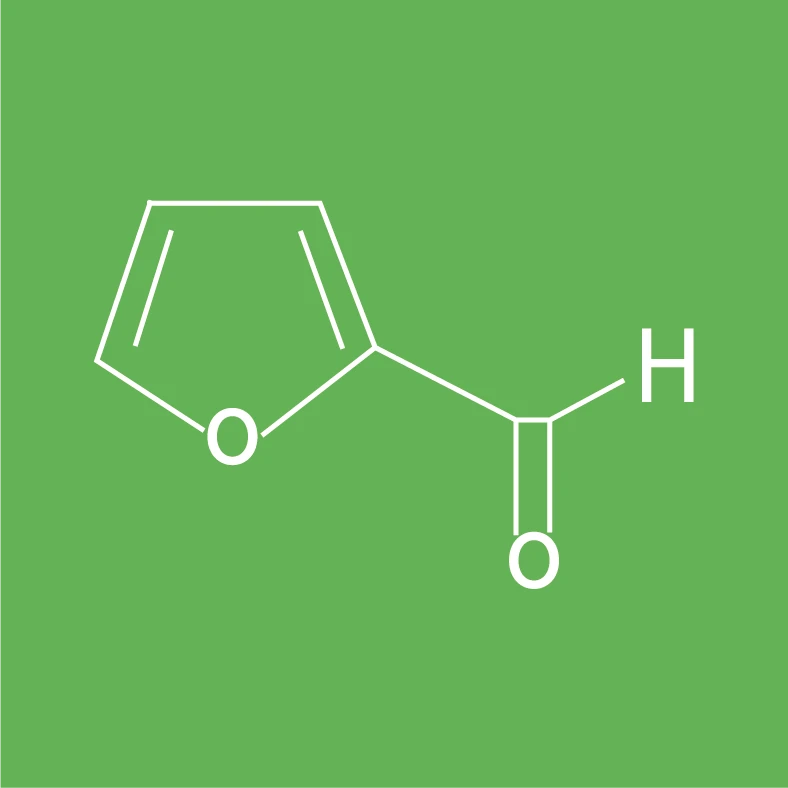

Let's start with sound absorption. Sound absorption is the ability of a material to take in sound energy and convert it into other forms of energy, usually heat. In the case of food grade furfural, its molecular structure plays a key role. The aldehyde group in furfural, along with its ring structure, can interact with sound waves in a way that allows it to absorb certain frequencies.
When sound waves hit a surface coated with or containing food grade furfural, the molecules start to vibrate. These vibrations cause internal friction within the furfural, which in turn dissipates the sound energy. However, the degree of sound absorption depends on several factors. The concentration of furfural, the thickness of the layer in which it's applied, and the frequency of the sound all matter.
For lower frequencies, food grade furfural might not be as effective at absorption. Lower - frequency sounds have longer wavelengths, and the molecular vibrations of furfural may not be able to keep up with the slower oscillations of these waves. On the other hand, for higher frequencies, the absorption can be relatively better. Higher - frequency sounds have shorter wavelengths, and the furfural molecules can more easily interact with these rapid oscillations, leading to more efficient energy conversion.
Now, let's talk about sound transmission. Sound transmission is about how well sound passes through a material. In a setting where you want to isolate a space from external noise, understanding the sound transmission properties of food grade furfural is essential.
Food grade furfural can act as a bit of a barrier to sound transmission. Its density and molecular structure contribute to this. The relatively compact structure of furfural molecules means that sound waves have a harder time passing through. When sound waves encounter a layer of food grade furfural, they have to interact with these molecules, which slows down their propagation.
However, it's important to note that food grade furfural alone might not be a super - effective sound - proofing material. In most cases, it would be used in combination with other materials to enhance its sound - blocking capabilities. For example, it could be mixed with polymers or incorporated into composite materials. These combinations can create a more robust barrier against sound transmission, as different materials can target different frequency ranges.
Sound reflection is another aspect of acoustic properties. Sound reflection occurs when sound waves bounce off a surface. For food grade furfural, the smoothness of the surface where it's applied and its interaction with the surrounding medium play a role in sound reflection.
If food grade furfural is applied to a smooth surface, sound waves are more likely to reflect off it. This can be both an advantage and a disadvantage. In some situations, like in a concert hall where you want to distribute sound evenly, a certain amount of reflection can be beneficial. But in other cases, such as in a recording studio where you want to minimize echoes, excessive reflection can be a problem.
So, how can these acoustic properties of food grade furfural be put to use? In the food industry, for example, it could be used in the construction of food processing facilities. These facilities often have a lot of machinery that generates noise. By using materials that incorporate food grade furfural, the noise levels can be reduced, creating a more comfortable working environment for employees.
In the packaging industry, food grade furfural could be used in the development of sound - absorbing packaging materials. This is especially useful for products that are sensitive to noise or for shipping environments where reducing noise can prevent damage to the contents.
In the context of our business as a food grade furfural supplier, understanding these acoustic properties gives us an edge. We can offer our customers not only a high - quality food grade chemical but also insights into its potential uses beyond the traditional applications.
If you're in an industry where noise control is a concern and you think food grade furfural could be a solution, I encourage you to reach out. We can have a detailed discussion about your specific needs, conduct tests if necessary, and find the best way to incorporate food grade furfural into your operations. Whether it's for sound absorption, transmission, or reflection, we're here to help you make the most of this versatile chemical.
To sum it up, the acoustic properties of food grade furfural are an interesting area of study. Its ability to absorb, transmit, and reflect sound depends on various factors related to its molecular structure and the way it's used. By leveraging these properties, different industries can benefit from better noise control. So, if you're interested in exploring the potential of food grade furfural for your acoustic needs, don't hesitate to contact us for a procurement discussion.
References
- General knowledge of organic chemistry and acoustic principles.
- Research on the applications of furfural in different industries.


