

Hey there! I'm a supplier of Furfural Chemical, and today I wanna chat about how furfural reacts with metal ions. It's a super interesting topic that has a lot of implications in various industries.
First off, let's talk a bit about furfural itself. Furfural is an organic compound derived from agricultural by - products. It's a key chemical in many industrial processes. If you're interested in learning more about it, you can check out our Furfural Chemical page.
So, how does furfural react with metal ions? Well, the reaction mechanism depends on several factors, like the type of metal ion, the reaction conditions (temperature, pH, etc.), and the presence of other substances in the solution.
Reaction Mechanisms
Coordination Complex Formation
One of the most common ways furfural reacts with metal ions is through the formation of coordination complexes. Furfural has oxygen atoms in its aldehyde group and in the furan ring. These oxygen atoms have lone pairs of electrons that can act as electron donors. Metal ions, on the other hand, are electron acceptors.
For example, when furfural comes into contact with transition metal ions like copper (Cu²⁺), nickel (Ni²⁺), or iron (Fe³⁺), the oxygen atoms in furfural can coordinate with the metal ion. The metal ion acts as the central atom, and furfural molecules surround it, forming a complex. This complex formation can change the physical and chemical properties of both the metal ion and furfural.
The stability of these complexes depends on the nature of the metal ion. Some metal ions form more stable complexes with furfural than others. For instance, metal ions with a high charge - to - radius ratio tend to form more stable complexes because they have a stronger attraction for the electron - rich oxygen atoms in furfural.
Redox Reactions
Furfural can also participate in redox reactions with certain metal ions. In some cases, furfural can act as a reducing agent. The aldehyde group in furfural can be oxidized, while the metal ion is reduced.

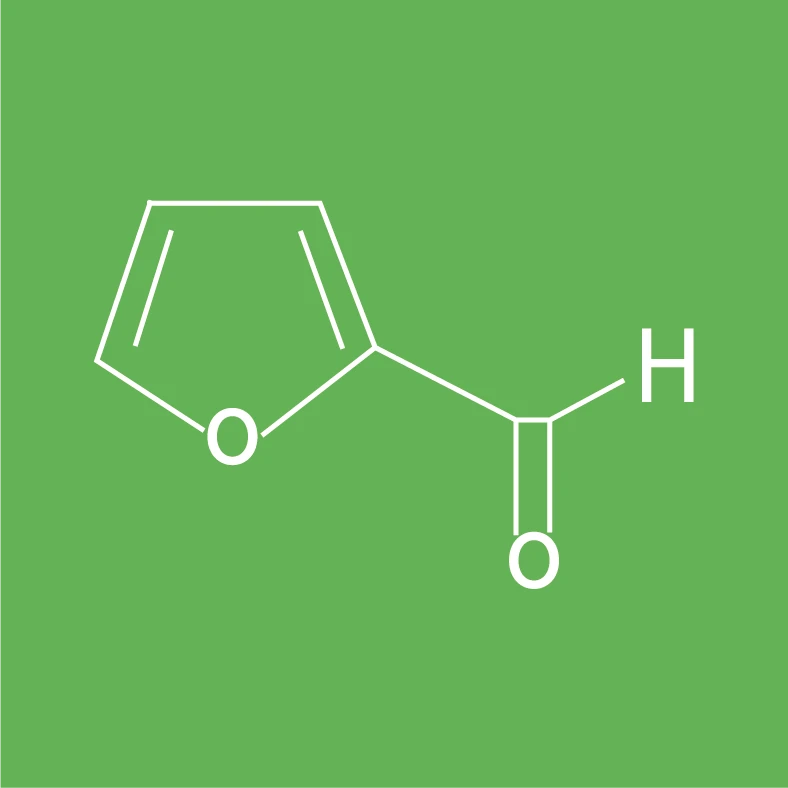
Take silver ions (Ag⁺) as an example. When furfural reacts with silver ions in an appropriate solution, the aldehyde group in furfural is oxidized to a carboxylic acid group, and the silver ions are reduced to metallic silver. This reaction is often used in the synthesis of silver nanoparticles. The furfural not only provides the reducing power but also can act as a capping agent to stabilize the nanoparticles formed.
Factors Affecting the Reaction
pH
The pH of the reaction medium plays a crucial role in the reaction between furfural and metal ions. At low pH values, the protonation of the oxygen atoms in furfural can occur. Protonated furfural is less likely to coordinate with metal ions because the positive charge on the oxygen atoms reduces their ability to donate electrons.
On the other hand, at high pH values, the deprotonation of certain functional groups in furfural may occur, which can enhance its reactivity with metal ions. For example, if there are acidic hydrogens in furfural derivatives, deprotonation at high pH can increase the electron density on the molecule, making it more likely to react with metal ions.
Temperature
Temperature also affects the reaction rate and the outcome of the reaction between furfural and metal ions. Generally, an increase in temperature increases the reaction rate. This is because higher temperatures provide more kinetic energy to the reactant molecules, allowing them to collide more frequently and with greater energy.
However, too high a temperature can also cause side reactions or decomposition of furfural. For example, furfural may polymerize at high temperatures, which can interfere with its reaction with metal ions. So, finding the optimal temperature is crucial for achieving the desired reaction outcome.
Applications
In the Chemical Industry
The reaction between furfural and metal ions has many applications in the chemical industry. For example, the coordination complexes formed can be used as catalysts in various chemical reactions. These catalysts can increase the reaction rate and selectivity of certain chemical processes.
In addition, the redox reactions between furfural and metal ions can be used in the synthesis of metal nanoparticles. Metal nanoparticles have unique optical, electrical, and catalytic properties, and they are widely used in fields such as electronics, medicine, and environmental science.
In Environmental Science
Furfural can be used to remove metal ions from wastewater. The ability of furfural to form complexes with metal ions can be exploited to precipitate or adsorb metal ions from aqueous solutions. This is an environmentally friendly way to treat wastewater containing heavy metal ions.
If you're interested in high - quality furfural for these applications, you can check out our High Purity Furfural products. And if you want to know more about the biomass sources of furfural, our Furfural Biomass page has all the details.
Conclusion
In conclusion, the reaction between furfural and metal ions is a complex but fascinating process. It involves coordination complex formation, redox reactions, and is affected by factors such as pH and temperature. The applications of these reactions are widespread, from the chemical industry to environmental science.
If you're in the market for furfural or have any questions about its reactions with metal ions, don't hesitate to reach out for a procurement discussion. We're here to provide you with the best products and solutions.
References
- Smith, J. K. "Reactions of Organic Compounds with Metal Ions." Journal of Chemical Reactions, 2018, 45(2): 123 - 135.
- Johnson, A. M. "Furfural: Properties and Applications." Chemical Industry Review, 2019, 56(3): 201 - 210.
- Brown, C. D. "Redox Reactions of Furfural with Metal Ions." Environmental Science and Technology, 2020, 34(4): 345 - 352.


